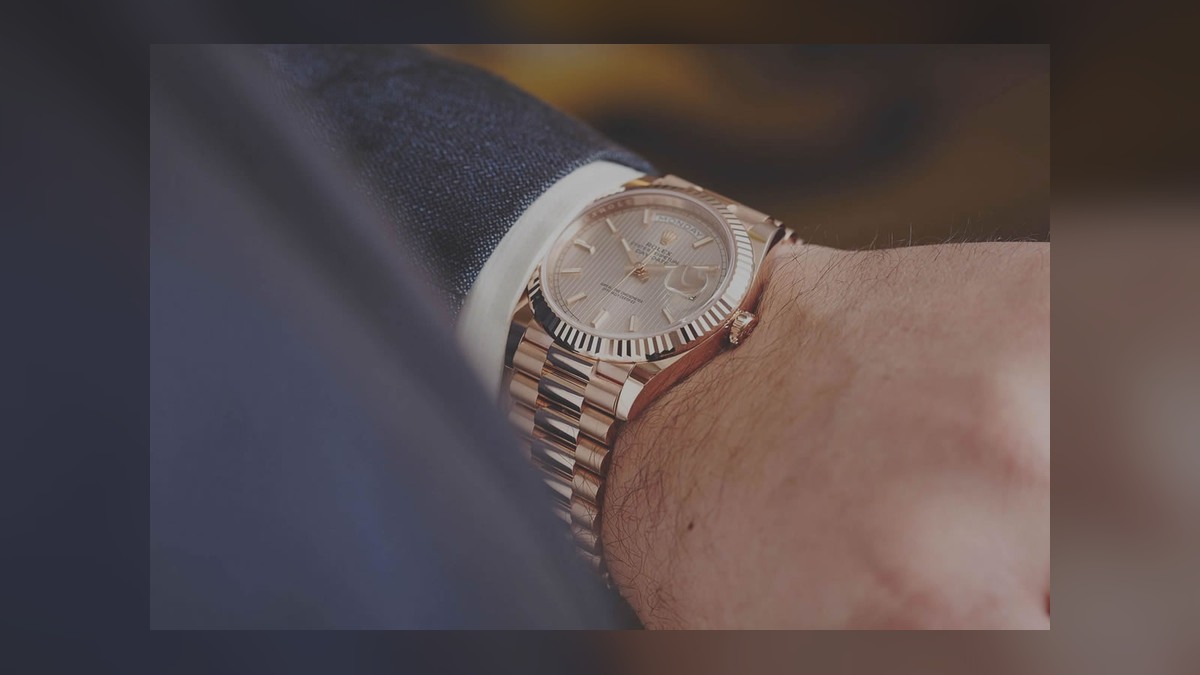
Rolex Day-Date Replica Guide
A detailed reference for judging Day-Date 36/40 proportions, calendar execution, President-style bracelets, movement claims, materials, water resistance and seller QC evidence.
A detailed reference for judging Day-Date 36/40 proportions, calendar execution, President-style bracelets, movement claims, materials, water resistance and seller QC evidence.
A useful Rolex Day-Date replica guide should begin with the architecture of the genuine watch. Without that baseline, words such as “Swiss,” “1:1,” “super clone,” “President,” or “904L” are only sales language.
Editorial review: . Genuine specifications were checked against Rolex and movement-maker documentation where available.
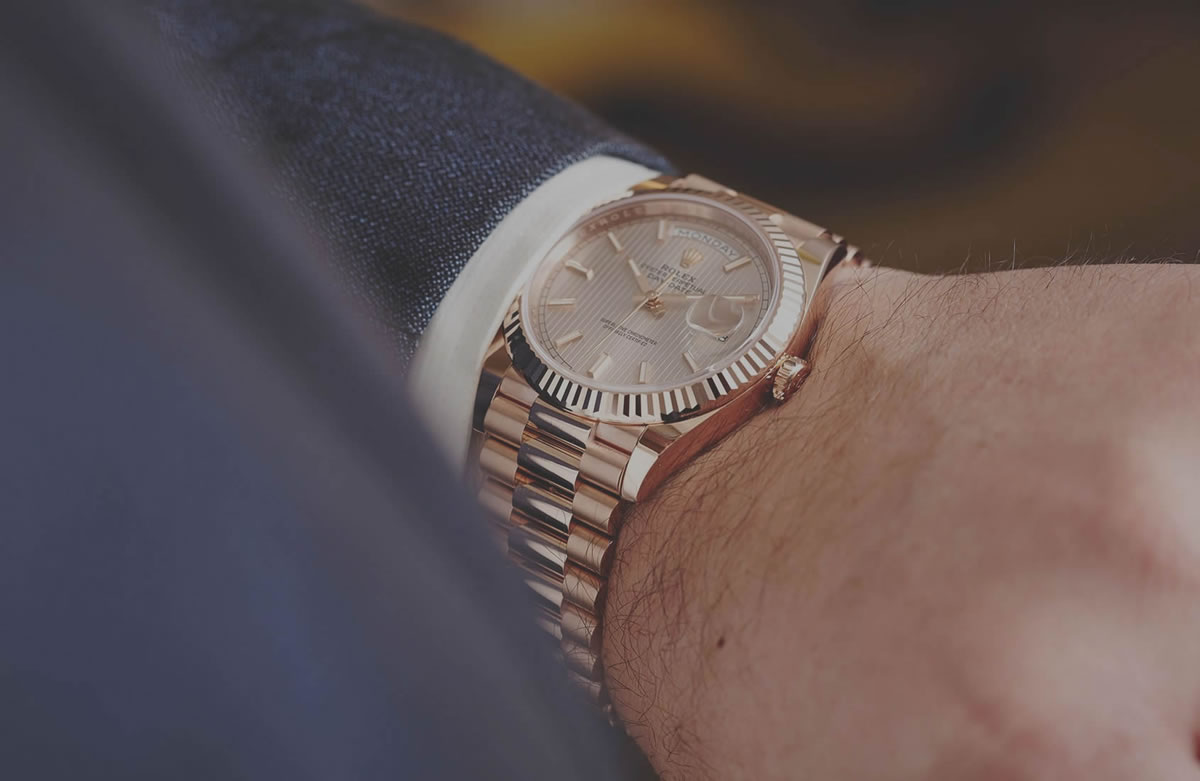
The modern Rolex Day-Date is offered in 36 mm and 40 mm cases and, according to Rolex, only in precious metals. Both current sizes use calibre 3255, show the day in a full-width aperture at 12 o’clock and the date at 3 o’clock beneath a Cyclops lens, and are rated by Rolex to 100 metres of water resistance. The President bracelet was created for the Day-Date in 1956 and uses semi-circular three-piece links. Those details give us a measurable reference against which a non-genuine watch can be evaluated.
Official references: Rolex Day-Date features, Rolex President bracelet, and Rolex Day-Date 40 technical details.
A replica may copy the broad visual language of a Day-Date—fluted bezel, President-style bracelet, full day display and Cyclops date—but that does not mean it shares Rolex materials, tolerances, movement architecture, water-resistance testing or finishing. The purpose of this guide is therefore not to repeat seller grades. It is to separate what can be checked from what must be taken on trust.
| Reference point | Day-Date 36 | Day-Date 40 | What to check on a replica |
|---|---|---|---|
| Case diameter | 36 mm | 40 mm | Ask for an actual measurement rather than relying on a model name. |
| Current genuine movement | Rolex calibre 3255 | Rolex calibre 3255 | A replica movement is not equivalent merely because a bridge or rotor is decorated to resemble Rolex. |
| Calendar | Full day at 12; date at 3 | Full day at 12; date at 3 | Check aperture centring, disc height, font, spacing and rollover behaviour. |
| Bracelet | President | President | Check end-link fit, articulation, clasp action, link edges and coating consistency. |
| Genuine material baseline | Precious metal only in the current Rolex collection | Steel, PVD, plating or other replica materials must be disclosed separately. | |
| Genuine water resistance | 100 m / 330 ft | Do not transfer this number to a replica unless that individual watch has independent pressure-test evidence. | |
A common mistake is to judge a replica only by the claimed diameter. Two watches can both measure 40 mm yet look very different because of bezel width, lug length, dial opening, case thickness and end-link geometry. On a Day-Date, the fluted bezel and President bracelet occupy a large part of the visual identity, so small proportional errors become obvious even when a specification sheet looks correct.
On weaker examples, the bezel may be too broad and visually shrink the dial, the lugs may be too thick, or the first bracelet links may sit too low relative to the case. Another recurring issue is a case side that appears overly slab-sided because polishing and transition lines are simplified. These are not “factory-name” questions; they are visible geometry questions that can be checked from straight-on, side-profile and end-link photographs.
The Day-Date is unusually unforgiving because it places two calendar displays on the dial. A watch can have an attractive case and bracelet yet still look wrong immediately if the day disc, date disc or magnifier is poorly executed.
Look for horizontal and vertical centring of the word inside the aperture, consistent baseline height from one weekday to the next, and adequate clearance around the letters. A seller should ideally provide photographs showing more than one weekday. A perfectly centred “MONDAY” does not prove that longer or differently shaped words remain centred.
The date should sit squarely beneath the magnifier. Inspect the relationship among the printed numeral, the physical date window and the centre of the Cyclops rather than judging magnification alone. A lens can magnify strongly yet still look wrong if it is positioned slightly high, low or sideways.
Rolex describes the genuine Day-Date as changing its day and date indicators rapidly around midnight through an interconnected calendar mechanism. A replica may use a slower change, a staged change, or a modified movement with different behaviour. That difference is not automatically a defect if it is disclosed; the problem is a seller claiming genuine-equivalent instantaneous operation without showing it. A short video from 11:55 p.m. through the changeover is much more useful than a static photograph.
Use macro photographs to inspect marker placement, repeated minute-track spacing, printing edges and the relationship between the coronet and the 12 o’clock day aperture. Avoid judging by dial colour alone because white balance, phone processing and seller lighting can make a dial appear warmer, cooler or more saturated than it is in person.
The genuine President bracelet uses semi-circular three-piece links and was created specifically for the Day-Date. Rolex states that it is made in precious metals. A replica bracelet can imitate the shape but may differ substantially in mass, link construction, coating, tolerances and clasp design.
Weight can provide a clue but not proof. A heavy watch is not automatically made from the metal a seller claims; added mass can come from case construction, bracelet components or internal parts. If material matters to the purchase, ask for the base metal and coating method in writing.
Movement wording is one of the easiest places for a listing to sound technical without being precise. MIYOTA publishes specifications for its calibres, which makes several common claims verifiable.
| Movement | Calendar function | Frequency | Published running time | Published accuracy | Why it matters for a Day-Date-style watch |
|---|---|---|---|---|---|
| MIYOTA 8205 | Day + date | 21,600 vph | Approx. 42 h | -20 / +40 sec/day | Stock architecture already provides both calendar indications, although the display layout is not automatically a drop-in match for a Rolex-style dial. |
| MIYOTA 8215 | Date only | 21,600 vph | Approx. 42 h | -20 / +40 sec/day | A listing that calls an unmodified 8215 a native “Day-Date” movement needs explanation because MIYOTA lists it as date-only. |
| MIYOTA 9015 | Date only | 28,800 vph | Approx. 42 h | -10 / +30 sec/day | Thinner and higher-frequency than the 82-series examples above, but still date-only in MIYOTA’s stock specification. |
This does not mean an 8215- or 9015-based replica can never display a day. Manufacturers can add modules or modify the calendar system. It means the seller should describe the actual architecture instead of implying that “MIYOTA 9015” by itself explains a full Day-Date display.
The current genuine Day-Date uses Rolex calibre 3255 with approximately 70 hours of power reserve and an instantaneous day/date display. A replica advertised as a “3255 clone” should therefore be judged by architecture and functions, not by decorative plates. Useful questions include: Does the crown-setting sequence match the claimed architecture? Does the day/date quick-set work as described? What is the measured power reserve? Is the movement serviceable with known parts? A display case-back photograph of a decorated rotor answers none of those questions by itself.
A higher beat rate can make the seconds hand appear smoother, but it does not prove better regulation, durability or calendar alignment. Conversely, a 21,600-vph movement may be robust and easy to service while looking less similar to the sweep of a modern Rolex calibre. The right comparison depends on what the buyer values: visual similarity, serviceability, power reserve, accuracy, or parts availability.
Current genuine Day-Date watches are precious-metal watches. That makes phrases such as “stainless-steel Day-Date,” “gold plated,” “PVD,” “wrapped,” or “solid gold” materially different descriptions, not interchangeable grades.
No responsible guide should promise that a coating “will never fade.” Wear depends on coating thickness and process, skin chemistry, abrasion, moisture, cleaning products and frequency of use. High-contact areas such as clasp edges and bracelet undersides deserve particular attention in long-term owner photos.
Rolex describes its steel as Oystersteel from the 904L family, but the Day-Date itself is not a current steel model. On a replica Day-Date, a “904L” claim therefore concerns the replica’s chosen base material, not fidelity to the genuine Day-Date’s material construction. If a seller uses the term as a quality badge, ask whether it applies to the case only or also the bracelet and clasp.
A seller who cannot answer every technical question may still have a perfectly usable watch. The problem is certainty without evidence. The following checklist turns vague grade names into specific things that can be photographed, measured or tested.
| Area | Ask for | What it helps verify |
|---|---|---|
| Case | Diameter, thickness and side-profile photograph | Whether the listed size and proportions are plausible. |
| Dial | Straight-on macro image without heavy sharpening | Marker alignment, printing, day/date centring and rehaut relationship. |
| Calendar | Photos of multiple weekdays/dates and a midnight rollover video | Disc centring, font consistency and changeover behaviour. |
| Movement | Exact calibre name, movement photo and crown-function video | Whether the movement claim matches the actual functions. |
| Bracelet | Clasp-open video and end-link close-ups | Construction, articulation, fit and finishing. |
| Material | Base metal plus coating method in writing | Prevents “gold,” “plated” and “solid” from being treated as the same claim. |
| Water resistance | Pressure-test result for the individual watch | Provides evidence specific to that unit rather than borrowing Rolex’s genuine 100 m rating. |
| QC | Actual-watch photos rather than only catalogue images | Helps catch dust, crooked markers, bezel alignment and cosmetic defects before shipment. |
Labels can change from seller to seller and are difficult for a buyer to independently audit. A measurable case, documented movement, actual-watch macro image and pressure test are stronger evidence because another person can evaluate them without trusting the label first.
Rolex rates current Day-Date models to 100 metres / 330 feet. That specification belongs to the genuine watch that has been designed and tested to Rolex standards. A visually similar replica does not inherit the rating.
If water exposure matters, the meaningful evidence is a pressure test on the actual watch after assembly—and ideally another test after case opening or service. “Waterproof,” “swim proof,” or “100 m style” without a test result should be treated as marketing rather than a technical specification.
Published movement specifications are useful as a reference, but the performance of a complete replica depends on regulation, assembly, lubrication, condition and any modules added to the base movement. Ask for a timegrapher reading if accuracy matters, but remember that one dial-up reading is not a complete multi-position test. For power reserve, a simple full-wind-to-stop measurement is more useful than repeating a claimed number from a product title.
There is no independent universal 1:1 certification system for replica watches. Treat it as a marketing label and return to measurable dimensions, photographs and functions.
Ask for the exact calibre and a clear movement photograph. “Swiss” can describe origin, architecture, a seller category or simply marketing wording; those are not the same thing.
This is more useful only when the seller gives the calibre number. As the 8205/8215/9015 comparison above shows, different MIYOTA movements do not even share the same calendar functions.
This is a material claim, not a colour description. It should not be used for gold-tone steel or plated metal. Precious-metal claims warrant independent verification because they materially affect value.
Ask for a pressure test on the individual unit. Appearance, screw-down crowns and case-back style are not water-resistance test results.
There is no single giveaway across every watch, but the combined day/date display is one of the best places to look. Mis-centred day text, inconsistent date numerals, an off-centre Cyclops and incorrect calendar behaviour can be easier to spot than a movement difference hidden behind a closed case back.
No. The 8205 has a native day/date function, which is relevant, but overall quality still depends on how the movement is integrated into the dial and case, how well it is regulated, and how the calendar is adapted. A movement model alone does not grade the complete watch.
MIYOTA publishes a tighter factory accuracy range for the 9015 (-10/+30 seconds/day) than for the 8215 (-20/+40 seconds/day), and the 9015 runs at 28,800 vph rather than 21,600 vph. The actual watch still needs individual regulation and testing.
Both correspond to current genuine Rolex Day-Date sizes. The choice is primarily about the intended reference and wrist proportion. A listing should not mix Day-Date II 41 mm, Day-Date 40 and Day-Date 36 terminology as if they were the same case.
No. Weight can make a watch feel different on the wrist but does not prove material, movement quality or dimensional fidelity. Construction and material disclosure matter more than a single gram figure.
No. Rolex’s 100 m figure applies to genuine Day-Date models tested to Rolex standards. A replica requires its own pressure-test evidence.
Ask for a straight-on macro photograph of the actual watch, an exact movement identification with a movement or crown-function video, and a side/end-link photo showing the case and bracelet fit. If you plan to expose the watch to water, replace one of those with an individual pressure test.
The main guide covers the complete evaluation process. These dedicated pages go deeper into one decision at a time so that size, movement, calendar, bracelet and material questions are not compressed into a single article.
| Topic | What the guide adds |
|---|---|
| Day-Date 36 replica | Classic 36 mm geometry, calendar crowding, bracelet scale and movement fit. |
| Day-Date 40 replica | Modern 40 mm proportions, 3255 reference baseline, case profile and QC. |
| Day-Date 36 vs 40 | Direct size and wrist-presence comparison without reducing the choice to diameter. |
| President bracelet | End links, three-piece geometry, clasp operation, coating wear and comfort. |
| Movement guide | MIYOTA 8205/8215/9015 functions and what “clone 3255” does and does not prove. |
| Dial & fluted bezel | Printing, markers, colour, sunray/ombré effects, stone-style dials and bezel geometry. |
| Calendar & Cyclops | Weekday/date alignment, lens centring, quick-set operation and midnight rollover. |
| Materials & finishes | Gold/Everose/platinum reference versus plated, coated and steel replica construction. |
| Buying guide | A step-by-step seller-question and actual-watch QC process. |
| History & references | 1956 origin, classic 36 mm, Day-Date II 41 mm and modern Day-Date 40 distinctions. |