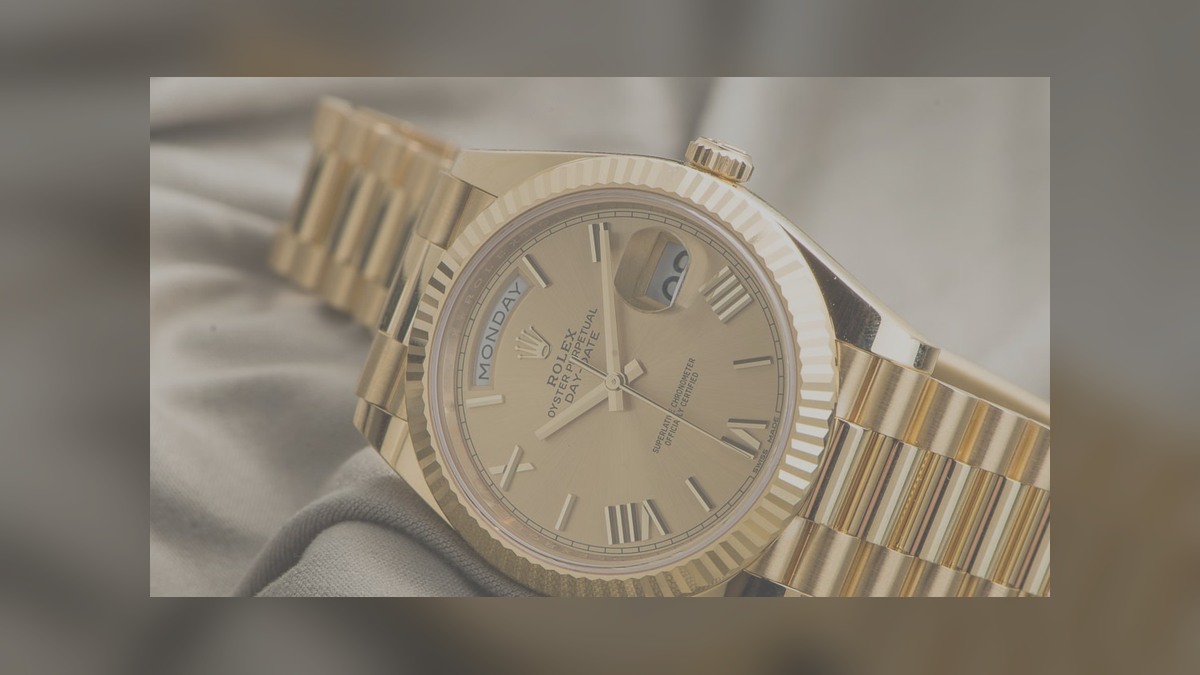
Rolex Day-Date 36 Replica Guide
How to judge a 36 mm Day-Date-style watch by proportion, calendar execution, President-style bracelet fit, movement architecture and material evidence.
How to judge a 36 mm Day-Date-style watch by proportion, calendar execution, President-style bracelet fit, movement architecture and material evidence.
The classic 36 mm format leaves very little room to hide errors. A thick bezel, oversized markers, a high day aperture or bulky bracelet links can change the entire character of the watch.
Editorial review: . Genuine Rolex specifications are used only as a reference baseline; replica construction, materials and water resistance must be verified separately.
The current genuine Day-Date 36 remains a 36 mm Oyster case, uses Rolex calibre 3255, carries the full weekday at 12 o’clock and date under a Cyclops at 3 o’clock, and is offered by Rolex only in precious metals. Rolex also specifies 100 metres of water resistance for the genuine watch. Those numbers provide a geometry and function baseline; they should never be copied automatically onto a replica listing.
A 36 mm replica therefore needs to be judged as a complete set of proportions. If the dial opening is too small, the bezel appears heavy. If the day aperture is enlarged to accommodate a generic calendar conversion, the 12 o’clock region can look crowded. If the first President-style links are too thick, the bracelet visually overwhelms the case.
Official baseline: Rolex Day-Date 36 technical details.
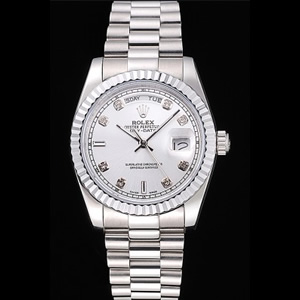
Diameter is only one measurement. Ask for a straight-on image and a side profile with the camera approximately level with the watch. The front view helps evaluate bezel width, lug spacing and dial opening; the side view reveals thickness, crystal height and crown placement.
On a compact watch, a small increase in bezel width has a large visual effect. Compare the width of the fluted bezel against the visible dial area instead of focusing on how sharply the flutes catch light. Strong studio lighting can exaggerate fluting and hide poor geometry.
The lugs should not look like four heavy blocks attached to a small dial. Check how the upper lug surface transitions into the polished case side and whether the end link meets the case without a vertical step. A gap is easier to notice on a 36 mm watch because the bracelet connection is close to the dial.
A calendar conversion or movement spacer can make a replica taller than expected. Thickness is not automatically a defect, but it changes the way the watch sits and can be a clue that the internal architecture differs substantially from the reference being copied.
A Day-Date has two moving printed discs. Request more than one weekday and more than one date. A manufacturer can centre “MONDAY” acceptably while another weekday rides high or low; a single-digit date can look fine while a double-digit date shifts sideways.
For a deeper calendar inspection, use the Day-Date calendar and Cyclops guide.
Rolex created the President bracelet for the Day-Date in 1956. On the genuine modern bracelet, the semi-circular three-piece links and concealed Crownclasp form a smooth visual transition from the case. A replica does not need the same materials to be wearable, but its dimensions and finishing should make sense for the smaller case.
Check the width and thickness of the first links, the taper toward the clasp, articulation when the bracelet hangs freely and the finish on inner surfaces. On plated or coated bracelets, the underside and clasp edges are especially useful because they are contact areas where inconsistent treatment appears earlier.
See the dedicated President bracelet replica guide for end-link, clasp and coating checks.
A compact case leaves less room for adaptation. MIYOTA’s 8205 natively provides day and date, while the 8215 and 9015 are date-only base movements. If a listing shows a full weekday but names a date-only calibre, ask what module or modification supplies the day function and whether it changes hand height, dial position or case thickness.
Do not assume a decorated movement is mechanically equivalent to Rolex calibre 3255. The useful questions are functional: exact calibre, beat rate, power reserve, calendar mechanism, crown sequence, regulation and availability of replacement parts. The movement guide compares these claims in detail.
The genuine Day-Date 36 is currently produced by Rolex only in precious metals. Replica 36 mm watches may use stainless steel, coated steel, plated base metal or other constructions while visually imitating yellow gold, Everose gold, white gold or platinum. A gold colour is not evidence of gold content.
Ask for the base metal, coating process and whether the case, bracelet, bezel, crown and clasp use the same finish. If a seller claims solid precious metal, independent material testing is proportionate to the value of that claim.
The 36 mm format appeals to buyers who want the traditional Day-Date proportions and a watch that does not dominate the wrist. It can also make finishing errors easier to see because each component occupies a larger percentage of the visible design. Buyers who prefer more wrist presence should compare it with the Day-Date 40 guide and the direct 36 vs 40 comparison.
A bright dial with slim markers can make the dial opening feel larger, while diamond-style markers, Roman numerals or a dark ombré effect can make the same case feel more visually concentrated. This is one reason two 36 mm watches can wear differently even when the cases are identical.
When evaluating a replica, compare marker height and width with the available dial space. Oversized applied markers can crowd the date aperture; a large coronet can squeeze the area above the day window. On gem-style dials, inspect whether settings are centred and consistent rather than judging sparkle under direct light.
On 36 mm, the fluted bezel occupies a meaningful percentage of the visible watch. A replica with deep but irregular flutes may look more dramatic in photographs yet less convincing in person than a subtler bezel with consistent spacing. Rotate the watch slowly under a fixed light source and watch whether the reflections move evenly around the circumference.
Also inspect the boundary between bezel and crystal. Uneven seating, a visibly wide gasket or an inconsistent gap can be more important than the sharpness of individual flutes.
Rolex has offered the Day-Date weekday display in many languages. A replica using an English disc may be easier to compare because photographs and references are abundant, while less common languages can make font and centring errors harder to judge. If you choose another language, ask to see the complete set of weekday positions rather than only the currently displayed word.
A 36 mm case is often chosen for comfort, but bracelet sizing can undo that advantage. Ask for the maximum and minimum wearable circumference, the number of removable links and whether the clasp lands near the underside centre of your wrist after sizing. A bracelet that cannot be balanced may cause the watch head to rotate despite the compact case.
It is closer in nominal size to the long-running classic format, but accuracy still depends on bezel width, lugs, dial layout, bracelet and movement fit.
No. A movement spacer or calendar conversion can increase thickness even in a 36 mm case. Request the actual side-profile measurement.
It is mechanically relevant because it has day and date natively, but the Rolex-style full weekday aperture still requires adaptation. Reliability of that adaptation matters more than the movement name alone.