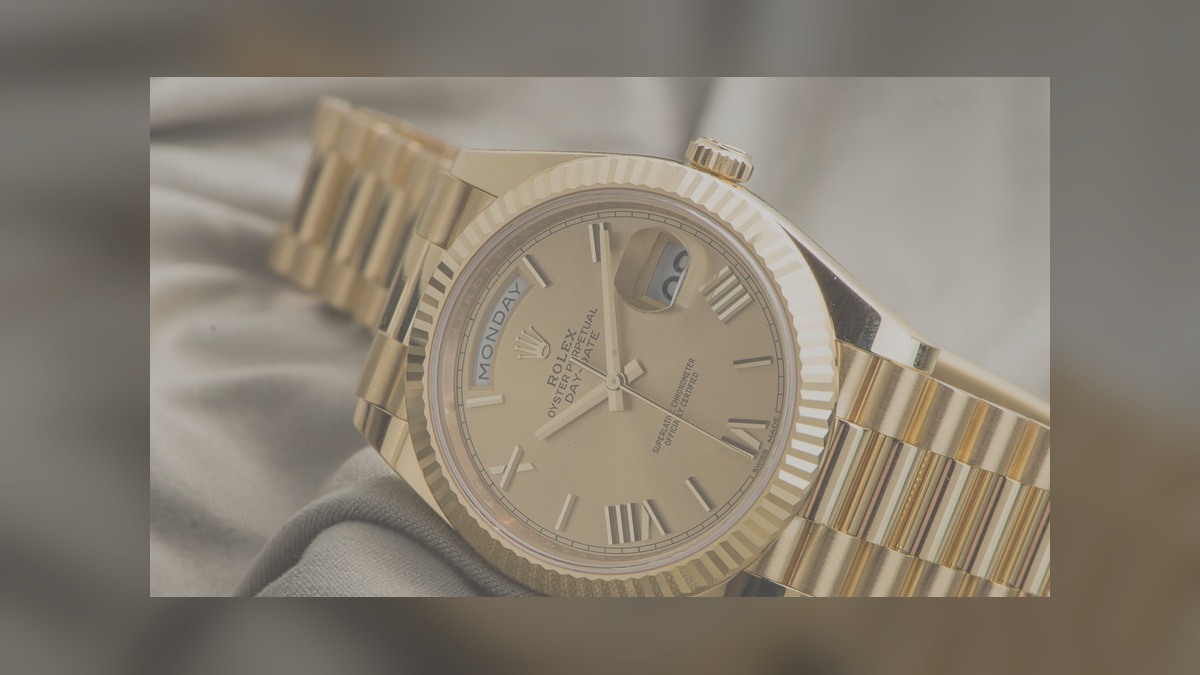
Rolex Day-Date Replica Guides
A structured Day-Date knowledge hub for model sizes, movement claims, calendar execution, President-style bracelets, materials, dial details and practical QC.
A structured Day-Date knowledge hub for model sizes, movement claims, calendar execution, President-style bracelets, materials, dial details and practical QC.
The Day-Date is simple to identify but surprisingly deep to evaluate. Case size, dial layout, calendar architecture, President bracelet construction, movement choice and material claims each create a different buyer question.
Editorial review: . Genuine Rolex specifications are used only as a reference baseline; replica construction, materials and water resistance must be verified separately.
This guide hub separates those questions so that a reader can move from a broad model overview into the exact subject that matters. The current genuine Day-Date is offered by Rolex in 36 mm and 40 mm sizes, exclusively in precious metals, with a full weekday aperture at 12 o’clock, date at 3 o’clock, calibre 3255 and a President bracelet. Those genuine specifications are a reference point, not a claim that a non-genuine watch duplicates the same construction.
Rolex traces the Day-Date to 1956, when the model introduced a calendar display with the weekday written in full. The President bracelet was created for the model at launch. That history is important because many replica listings mix terminology from several generations—Day-Date 36, Day-Date II and Day-Date 40—without distinguishing case dimensions or movement architecture.
Official references: Rolex Day-Date features, Rolex history 1953–1967, and President bracelet.

| Guide | Best for | Main questions answered |
|---|---|---|
| Day-Date 36 replica guide | Classic 36 mm proportions | Case geometry, dial opening, bracelet scale, calendar alignment and movement fit. |
| Day-Date 40 replica guide | Modern 40 mm format | Lug shape, bezel width, 3255 reference baseline, bracelet integration and weight claims. |
| Day-Date 36 vs 40 | Choosing a size | Wrist presence, proportion, dial spacing, bracelet scale and replica-specific compromises. |
| Day-Date II 41 mm guide | Older large-case generation | Why Day-Date II is not the same watch as Day-Date 40. |
President bracelet construction deserves its own guide because end links, link articulation, clasp mechanics and surface treatment often reveal more than a factory label. The calendar and Cyclops guide focuses on the two displays that make the Day-Date unusually unforgiving: the full weekday aperture and magnified date window.
The dial and fluted-bezel guide covers minute-track spacing, applied markers, coronet placement, sunray and lacquer effects, stone-inspired dials and bezel geometry. The materials guide separates genuine Rolex gold/platinum references from plated, coated and steel replica constructions so that colour is not mistaken for material.
Listings often use words such as “Swiss,” “Japanese,” “3255 clone” or “super clone” as if they were standardized specifications. They are not. The Day-Date movement guide begins with functions that can be verified: whether the base calibre supports day and date natively, beat rate, power reserve, crown positions and serviceability. MIYOTA publishes that the 8205 provides day and date, while 8215 and 9015 are date-only base movements. That distinction matters whenever a seller claims one of those date-only movements inside a watch that shows a full weekday.
The Day-Date buying guide turns the technical material into a sequence: identify the intended reference, request actual-watch QC images, confirm movement architecture, inspect calendar alignment, ask for material disclosure and request pressure-test evidence if water resistance matters. This method is intentionally independent of seller-created grades.
Finally, the history and reference guide explains why 36 mm, Day-Date II and Day-Date 40 should not be collapsed into one model name. It is useful when a listing borrows a modern dial, an older case size and a generic movement description in the same product title.
If you already know the exact size and configuration you want, begin with the 36 mm or 40 mm guide. If you are still deciding on size, start with the direct comparison. Buyers who have already chosen a model but are unsure about a seller’s technical claims should jump to the movement, calendar or materials pages. The buying guide is designed for the final stage when you need a repeatable QC process rather than more model history.
Model pages focus on proportions that are difficult to discuss generically. A 36 mm case can look wrong because a generic bracelet overpowers it; a 40 mm case can look wrong because extra movement height turns the side profile into a slab. Day-Date II adds a third geometry because its 41 mm generation is not simply an oversized current Day-Date 40.
Component guides isolate problems that appear across several models. A poorly centred weekday disc is a calendar issue whether the case is 36 or 40 mm. A sharp clasp edge is a bracelet issue regardless of dial colour. Separating these components makes it easier to compare two watches without letting a strong dial distract from a weak movement or bracelet.
Some claims cannot be verified from a photograph. Alloy grade, solid-gold content, pressure resistance and internal movement architecture require stronger evidence. The library repeatedly distinguishes visual inspection from documentary or test evidence so that a buyer knows when a photograph is enough and when it is not.
Rolex’s current collection gives several stable points of comparison: 36 and 40 mm case sizes; full weekday and date display; calibre 3255; President bracelet; precious-metal construction; sapphire crystal with Cyclops; and a 100-metre water-resistance rating for the genuine watch. The collection also includes a wide range of dial treatments, from lacquer and sunray effects to decorative stone and gem-set variations.
These details should not be copied into a replica specification sheet without evidence. Their purpose here is to define the design and function that a replica is attempting to imitate. A steel case can still be visually well made, but it should be called steel; a modified movement can still work well, but it should not inherit calibre 3255 specifications merely because it resembles the genuine movement through a display back.
Factory names, “AAA,” “1:1,” “Swiss grade,” “super clone” and similar labels are not treated as universal standards because there is no independent specification behind them. The guides instead use measurements, functions, materials, photographs and videos that can be requested from any seller. This makes the comparison portable even when seller naming changes.