Rolex Day-Date Replica Dial & Fluted Bezel Guide
How to evaluate dial printing, applied markers, colour, stone-inspired finishes, weekday aperture placement and the geometry of a Day-Date fluted bezel.
How to evaluate dial printing, applied markers, colour, stone-inspired finishes, weekday aperture placement and the geometry of a Day-Date fluted bezel.
Movement quality matters, but the eye reaches the dial, day aperture, Cyclops and fluted bezel first. These are also the areas where lighting can make a weak replica appear stronger than it is.
Editorial review: . Genuine Rolex specifications are used only as a reference baseline; replica construction, materials and water resistance must be verified separately.
Rolex offers the genuine Day-Date with a broad range of dial finishes and materials. Official pages describe lacquered, sunray, ombré, mother-of-pearl and decorative-stone dials across different references. The genuine fluted bezel began as a functional design element and today is a signature feature crafted by Rolex in precious metal.
Official references: Day-Date features and Eisenkiesel Day-Date 36 example.
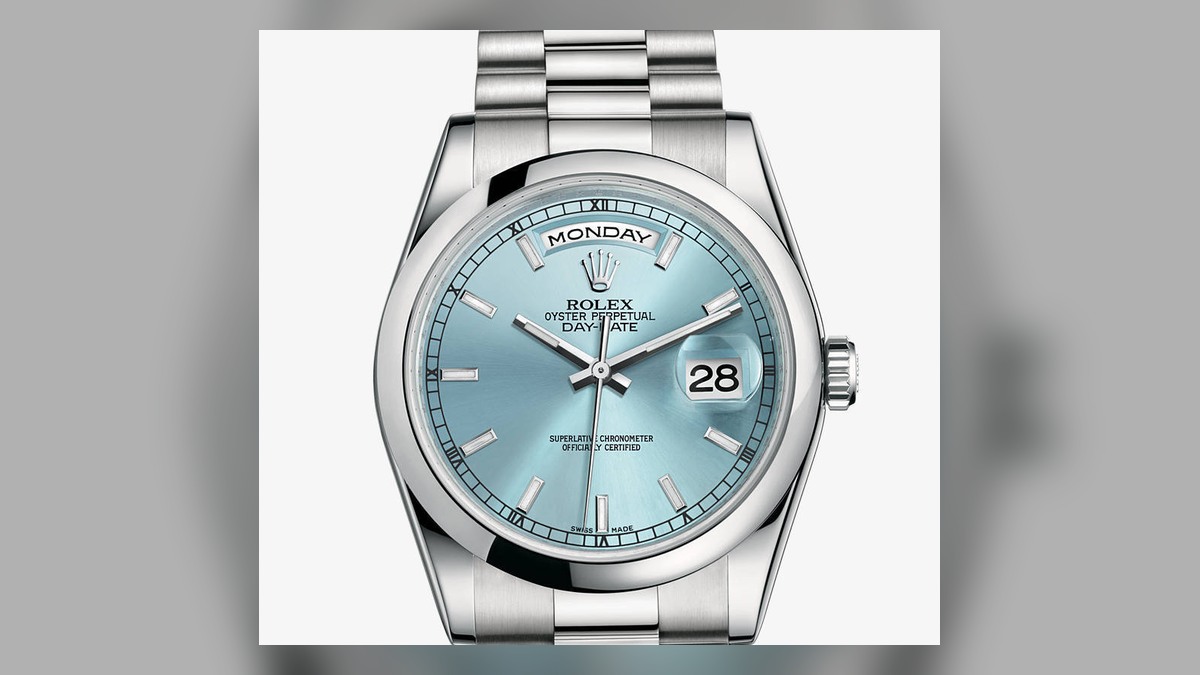
Colour varies dramatically with camera white balance and image processing. Printing geometry is more stable. Inspect the minute track, coronet, model text, applied markers and the relationship between the 12 o’clock day aperture and surrounding elements.
Look for repeated consistency rather than one attractive detail. Minute hashes should maintain rhythm around the dial. Applied markers should share orientation and sit level. The coronet should not appear shifted in relation to the central axis.
The aperture’s width, height and vertical position affect the entire upper half of the dial. If it is too large, the coronet and upper text can feel compressed; if too high or low, the dial loses symmetry. Compare several weekday words because different text lengths reveal disc centring problems.
Rolex describes genuine sunray finishing as fine grooves radiating from the dial centre, producing changing reflections as the wrist moves. On a replica, look for a consistent radial effect rather than patchy metallic paint. A short rotating video under neutral light is more informative than a single flash photograph.
On lacquer-style dials, inspect surface smoothness and whether printed text remains crisp above the finish. On ombré-style dials, look at the transition from the central colour to the darker perimeter. An abrupt ring can look artificial; a seller’s vignette or photo editing can also fake a gradient, so request video.
Decorative dials can be printed or manufactured from different materials to imitate natural stone or mother-of-pearl. Visual variation alone does not prove the substrate. If the material is important, ask what the dial is actually made from rather than accepting a model nickname.
Inspect whether stones or simulated stones are centred within their settings, whether the settings align with the minute track and whether all markers sit at a consistent height. Uneven prongs or glue residue can become visible in macro images.
A sharply photographed bezel can look impressive even when the flutes are too broad, too shallow or inconsistent. Evaluate the regularity of the pattern around the full circumference, the boundary between bezel and crystal and the bezel-to-dial ratio.
On the genuine current Day-Date, Rolex states that the fluted bezel is precious metal. A replica may machine a similar pattern into plated or coated base metal. Material and geometry are separate questions.
For the moving calendar components, continue to the calendar and Cyclops guide.
Where a replica includes engraved or printed details around the inner case wall, check whether they maintain consistent spacing and alignment relative to the minute track. Do not use one engraving as an authenticity test; use the whole circular geometry as a finishing check.
Check hand length, thickness, finish and vertical spacing. The minute hand should relate naturally to the outer track, and the seconds hand should not look visibly too short. On luminous configurations, compare the colour and intensity of hand lume with marker lume under the same exposure.
Baton markers make rotational misalignment easy to see. Roman numerals can reveal inconsistent spacing or applied-element height. Gem-style dials add setting symmetry and alignment questions. A strong dial is not just one with an attractive colour; it preserves the internal geometry of its own design.
Rolex has produced Day-Date displays in many languages. Longer words, accented characters and different letter shapes can reveal poor printing or centring. If a replica offers a less common language disc, request the full seven-day sequence before purchase.
Reflections from the crystal and Cyclops can make black dials look grey or coloured dials appear washed out. When comparing seller images, use similar lighting and angle. A difference in photograph colour does not necessarily indicate a different dial batch.
Inspect the seam between bezel and mid-case around the full circumference. Uneven seating can suggest assembly or machining issues. Also check whether the bezel appears level relative to the crystal. Strong fluting does not compensate for a bezel that is visibly tilted.
No. Photography can shift colour. Printing, marker alignment, aperture placement and surface consistency are more reliable from images.
No. Printed and composite materials can imitate natural variation. Material identity needs separate disclosure.
Individual reflections change with angle, but the spacing and geometry of the flutes should remain regular around the circumference.