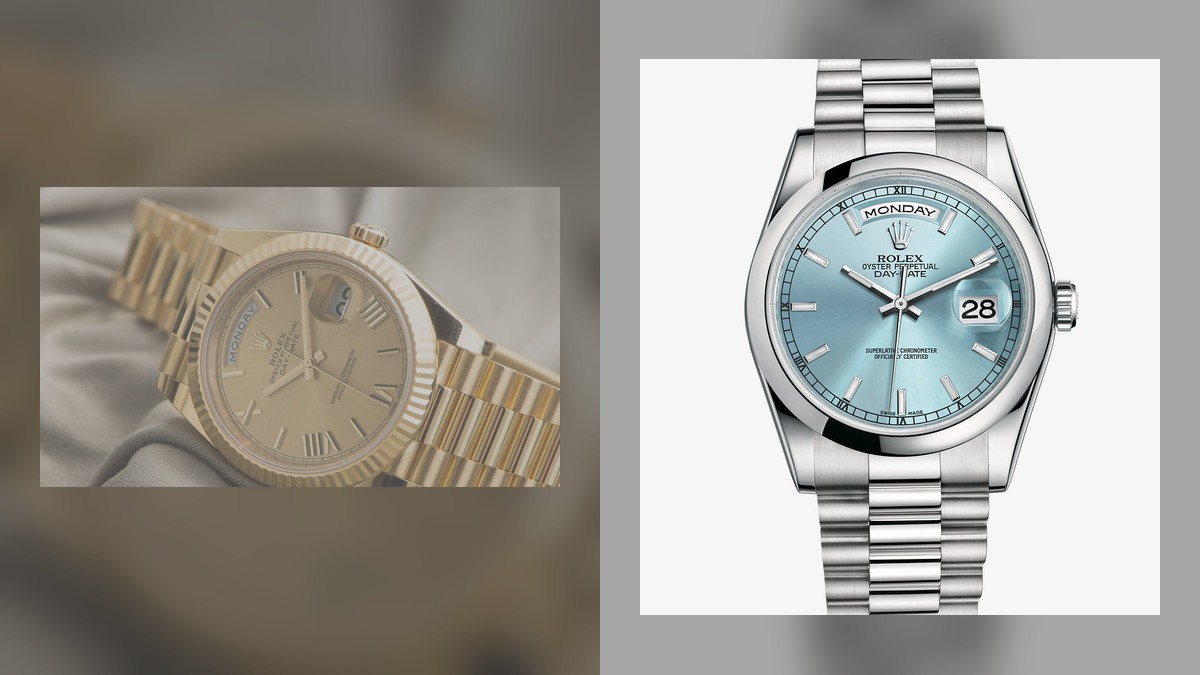
Rolex Day-Date 36 vs 40 Replica Comparison
A practical size comparison based on proportion, wrist presence, calendar layout, bracelet scale and the replica-specific compromises that diameter alone cannot show.
A practical size comparison based on proportion, wrist presence, calendar layout, bracelet scale and the replica-specific compromises that diameter alone cannot show.
Choosing between them is not simply choosing small or large. The bezel, dial, lugs, calendar apertures and President bracelet all occupy different proportions.
Editorial review: . Genuine Rolex specifications are used only as a reference baseline; replica construction, materials and water resistance must be verified separately.
Rolex currently offers the Day-Date in both 36 mm and 40 mm, each using calibre 3255 and a President bracelet. Both genuine sizes are specified to 100 metres of water resistance and produced in precious metals. That common mechanical baseline makes the size comparison especially useful: many visible differences come from geometry rather than a completely different function set.
| Area | 36 mm | 40 mm | Replica implication |
|---|---|---|---|
| Wrist presence | Traditional, compact | Broader, more contemporary | Large lugs or thick bezel are more obvious when proportions miss the intended size. |
| Dial space | Tighter | More open | Calendar-window and marker positioning errors present differently. |
| Bracelet scale | Needs restrained link mass | Can visually support larger first links | Generic bracelets can overwhelm 36 mm or look undersized on 40 mm. |
| Case adaptation | Less internal room | More room but greater side-profile visibility | Movement spacers and calendar modules can change thickness on either size. |
| Best inspection view | Straight-on and bracelet transition | Straight-on plus side profile | Actual measurements matter more than seller model names. |
Conventional advice often maps 36 mm to smaller wrists and 40 mm to larger wrists. That is a starting point, not a rule. Flat wrist shape, preference for bracelet drape, clothing style and tolerance for visual weight also matter. A 40 mm watch with compact lugs can wear more comfortably than a nominally smaller watch with a bulky generic case.
Because the dial opening is smaller, large markers, thick hands or an oversized day aperture can make the centre of the watch look congested. On a weak 36 mm replica, the maker may have adapted a calendar module without sufficiently redesigning the dial. Check the distance from the day aperture to the coronet, the breathing room around the date window and the minute-track spacing.
The larger watch gives the case side and lugs more surface area. A slab-like profile, thick lugs or a poorly fitting end link can therefore dominate the view. Side photographs are particularly valuable on 40 mm replicas because they show whether extra movement height has been hidden inside an unusually tall mid-case.
Both replica sizes can be built around different movement solutions. A native day/date base such as MIYOTA 8205 solves one functional problem but may require adaptation to produce the full-width weekday at 12. A date-only movement such as 8215 or 9015 requires an additional day mechanism if the listing is accurate. The case size does not make those engineering questions disappear.
The President-style bracelet is visually dense because of its three-piece semi-circular links. On 36 mm, oversized first links can make the watch appear bracelet-heavy. On 40 mm, underbuilt links can make the case look detached. Compare the taper and end-link geometry rather than focusing only on bracelet weight.
Neither is automatically easier, but different defects stand out. On 36 mm, use macro front photographs to inspect crowding, printing and calendar placement. On 40 mm, add side and three-quarter views to inspect lug shape and thickness. In both cases, ask for actual-watch QC and a calendar rollover video.
For model-specific detail, continue to the Day-Date 36 guide or Day-Date 40 guide.
When two actual watches are available, compare three ratios rather than diameter alone: bezel width relative to dial opening, lug length relative to case diameter, and first-link thickness relative to lug thickness. These ratios explain why one 40 mm watch can look balanced while another appears top-heavy.
Product images are often cropped so the watch fills the same frame. That removes scale. Ask for a wrist photo with wrist circumference stated or a photograph beside a ruler. Avoid using the crown in diameter measurements unless the seller specifically states that convention.
The 40 mm dial can provide more visual space around the full weekday and date, which some buyers find easier to read. The 36 mm layout feels denser and more traditional. Replica typography matters in both: oversized text can crowd the smaller dial, while undersized text can look lost on the larger one.
A smaller watch with a stiff bracelet can wear larger than expected because the first links refuse to drop around the wrist. A larger watch with well-articulated links can feel more secure. Ask for a free-hanging bracelet video and look at how quickly the first links curve downward.
Many buyers assume 36 mm will automatically be thinner. That is not guaranteed in replica construction. If a 36 mm build requires a tall movement/calendar stack, it can sit higher than a better-engineered 40 mm build. Always compare diameter and thickness together.
Search popularity should not decide what you wear. The useful decision is which geometry, dial density and bracelet scale suits your preference. The site keeps separate pages for 36 and 40 because the QC issues are genuinely different, not because the same text has been duplicated under two keywords.
| If you prioritize… | Usually start with… |
|---|---|
| Traditional Day-Date proportion | 36 mm |
| More modern wrist presence | 40 mm |
| Maximum dial breathing room | 40 mm |
| Compact bracelet-to-case balance | 36 mm |
| Older oversized generation | Day-Date II 41 mm |