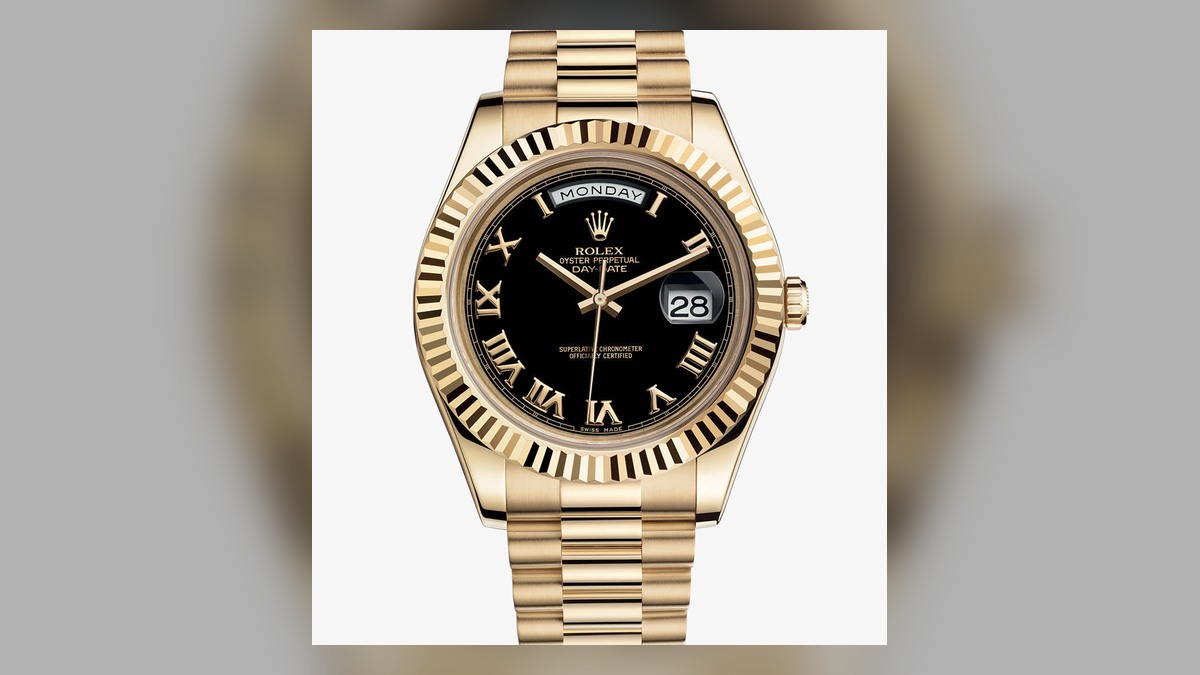
Rolex Day-Date Replica Materials & Finishes Guide
How to separate colour from composition when listings use yellow-gold, Everose, white-gold, platinum, 904L, plating and coating terminology.
How to separate colour from composition when listings use yellow-gold, Everose, white-gold, platinum, 904L, plating and coating terminology.
A replica can reproduce a yellow, rose or silver appearance without using the same alloy. Material disclosure should therefore be evaluated independently from colour and model name.
Editorial review: . Genuine Rolex specifications are used only as a reference baseline; replica construction, materials and water resistance must be verified separately.
Rolex states that current Day-Date watches are made only in 18 ct yellow, white or Everose gold, or 950 platinum. Rolex describes Everose as an 18 ct pink-gold alloy introduced in 2005. These facts are useful reference points because replica listings often borrow the same colour vocabulary.
Official references: Rolex Everose and Rolex Day-Date collection.
| Question | Example answers | Why it matters |
|---|---|---|
| Base metal | Stainless steel, brass, another alloy, claimed solid gold | Controls corrosion behaviour, density, machining and value. |
| Surface treatment | Electroplating, PVD-style coating, other deposited finish | Controls wear pattern and refinishing options. |
| Colour target | Yellow gold, rose/Everose style, white-gold style, platinum style | Describes appearance, not composition. |
Warm colour can be intensified by seller lighting. Ask for neutral-white or daylight images and inspect inner clasp edges, bracelet undersides, screw recesses and case-back contact points. These areas experience friction and may reveal the base colour earlier than the top surface.
Rolex Everose is a proprietary 18 ct alloy. A replica can only target its visual hue unless it independently uses a comparable precious-metal composition. Rose coatings can vary from copper-heavy orange to cool pink. Compare case and bracelet under the same light because mismatched batches are common.
Stainless steel, coated steel, white gold and platinum can all appear broadly silver in photographs. Density and alloy verification require more than colour. If a seller claims a precious metal, ask for independent assay or material testing appropriate to the purchase value.
It is a specific stainless-steel grade claim, not a synonym for high quality. A buyer cannot reliably verify alloy grade from photographs. If the grade matters, ask for supplier documentation or independent material analysis. More importantly, inspect machining, finishing, corrosion resistance in use and whether all advertised components use the same base metal.
A very light watch can indicate hollow or low-mass construction, but a heavy watch does not prove solid precious metal. Internal ballast, thick steel components and bracelet design all influence total weight. Compare weight only between clearly specified constructions and avoid treating one number as authentication.
Micron claims sound precise, but they are meaningful only if the measurement method and coverage are known. Ask whether the stated thickness applies to the case, bracelet and clasp equally and whether high-friction surfaces receive the same process. A single supplier number should not be assumed to describe every component.
Bracelet-specific wear points are covered in the President bracelet guide.
Two watches described with the same process can age differently because surface preparation, layer thickness, adhesion and post-finishing differ. Marketing labels such as PVD do not tell you the complete process. Long-term owner photographs of the same supplier can be more informative than a fresh product shot.
A case, bezel, bracelet and clasp do not necessarily share one substrate. Ask whether the entire watch uses the advertised base metal. Different components can take colour differently and develop different wear patterns even when the initial appearance matches.
A scratch on bare stainless steel normally reveals more steel; a deep scratch through gold-tone coating can expose a contrasting substrate. This does not mean coated watches cannot be worn daily, but buyers should understand the maintenance trade-off.
Precious metals have distinctive densities, but a finished watch contains movement, crystal, seals and sometimes mixed materials. Total watch weight cannot be converted directly into an alloy claim. Professional material analysis is stronger evidence when a seller makes an expensive precious-metal claim.
A silver case with an ice-blue dial may intentionally imitate a well-known platinum visual combination. Clear product wording should distinguish “platinum-style colour” from “platinum case.” The same principle applies to Everose-style and yellow-gold-tone replicas.
No. The current genuine Day-Date is precious-metal construction, and alloy grade alone says nothing about movement, finishing or assembly quality.
No. It can be supporting information, but professional material verification is stronger.
Not automatically. Process quality, substrate preparation, thickness and use conditions all matter.